Hey there! As a supplier of Rotary Drum Screens, I'm super excited to dive into the topic of "What is the screening efficiency of a Rotary Drum Screen?"
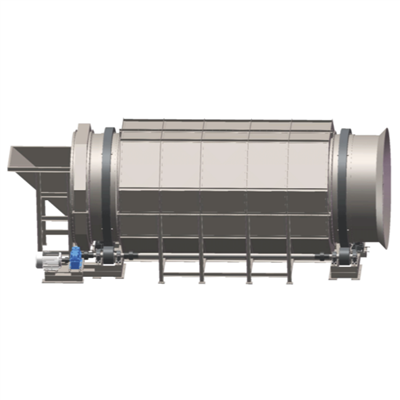
Let's start with the basics. A Rotary Drum Screen is a key piece of equipment in sewage treatment and many other industries. It's used to separate solids from liquids, and its efficiency can make or break the whole process. But what exactly does screening efficiency mean? Well, it's basically a measure of how well the screen can separate the solid particles from the liquid stream.
One of the main factors that affects the screening efficiency of a Rotary Drum Screen is the size of the screen openings. If the openings are too large, then some of the smaller solid particles might pass through with the liquid, reducing the efficiency. On the other hand, if the openings are too small, the screen might get clogged easily, which also messes up the efficiency. So, finding the right size of screen openings is crucial. For example, in a sewage treatment plant, if you're dealing with mostly large debris like branches and plastic bags, you can use a screen with relatively large openings. But if there are a lot of fine particles in the sewage, you'll need a screen with smaller openings.
Another important factor is the rotation speed of the drum. A faster rotation speed can increase the throughput of the screen, meaning it can process more liquid in a given time. However, if the speed is too high, the solid particles might not have enough time to be properly separated from the liquid. They could just get swept along with the liquid and pass through the screen. So, you have to find that sweet spot for the rotation speed. Usually, it depends on the characteristics of the material being screened. If the liquid has a high viscosity or the solid particles are very sticky, a slower rotation speed might be better to ensure proper separation.
The design of the Rotary Drum Screen also plays a big role in its screening efficiency. Some screens have special features like internal baffles or brushes. The baffles can help to direct the flow of the liquid and solids inside the drum, making the separation process more efficient. The brushes, on the other hand, can clean the screen surface as it rotates, preventing clogging. For instance, in a food processing plant where there might be a lot of sticky substances, a screen with brushes can be really useful to keep the screen working smoothly.
Now, let's talk about how we can measure the screening efficiency. One common way is to calculate the percentage of solid particles that are successfully separated from the liquid. You can do this by taking samples of the influent (the liquid and solids mixture going into the screen) and the effluent (the liquid coming out of the screen) and analyzing the amount of solids in each. The formula for calculating the screening efficiency is:
Screening Efficiency (%) = [(Amount of solids in influent - Amount of solids in effluent) / Amount of solids in influent] x 100
This gives you a clear idea of how well the screen is doing its job.
In addition to these factors, the quality of the materials used to make the Rotary Drum Screen is also important. High - quality materials can ensure that the screen is durable and can withstand the wear and tear of continuous operation. For example, using corrosion - resistant materials is essential if the screen is going to be used in a harsh chemical environment.
When it comes to different industries, the requirements for screening efficiency can vary widely. In the mining industry, for example, the goal might be to separate valuable minerals from the ore as efficiently as possible. A Rotary Drum Screen with high screening efficiency can help to increase the recovery rate of these minerals. In the paper industry, the screen is used to remove impurities from the pulp, and a high - efficiency screen can improve the quality of the final paper product.
We also offer a range of related equipment that can work in conjunction with the Rotary Drum Screen to enhance the overall treatment process. For example, the IC Anaerobic Reactor can be used to treat the liquid after it has passed through the screen, breaking down organic matter. And the Peripheral Driving Sludge Thickener can be used to further process the solid waste separated by the screen.
If you're in the market for a high - efficiency Rotary Drum Screen, look no further. Our Rotary Drum Screen is designed with the latest technology and high - quality materials to ensure maximum screening efficiency. Whether you're in the sewage treatment, food processing, mining, or any other industry that requires solid - liquid separation, we've got you covered.


We understand that every customer's needs are different, so we offer customized solutions. Our team of experts can work with you to determine the best screen size, rotation speed, and other parameters based on your specific requirements. We also provide excellent after - sales service to make sure your Rotary Drum Screen keeps running smoothly for years to come.
If you're interested in learning more about our Rotary Drum Screens or want to discuss your project in detail, don't hesitate to reach out. We're always happy to have a chat and see how we can help you improve your screening process and achieve better results.
References
- "Solid - Liquid Separation Technology" by John Doe
- "Sewage Treatment Handbook" by Jane Smith
- Industry reports on screening equipment efficiency